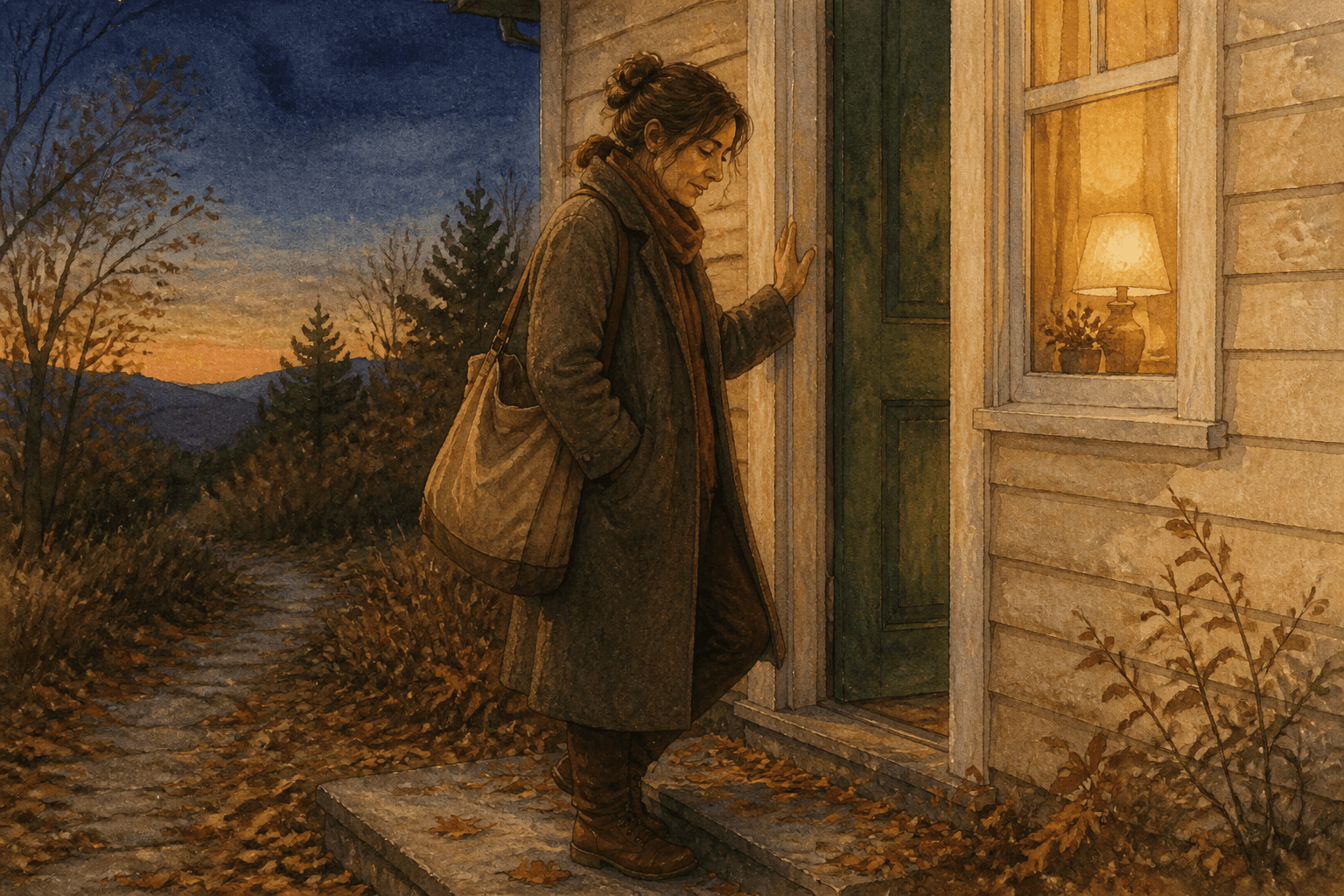
It usually goes sometime in October.
You had it in September. The morning thing before the phone. The pause at the door before you went in. The one moment in the day you let yourself notice. Nothing heroic, just a small practice that had started to hold.
Then the mornings get dark. The school calendar fills in. Work starts talking about year-end, somebody in the family starts talking about the holidays, and by the third week of the month you realize you have not done the morning thing since the ninth.
This letter is for the version of you standing in that third week, wondering whether to start again.
What the popular advice misses
The usual advice is to recommit. Get back on it. Set the alarm ten minutes earlier and do the whole routine, properly this time, maybe with a new app.
That asks the most of you in the season when you have the least. It also reads the lapse as a failure of discipline, and most of the time it has very little to do with discipline.
Why practices break in the fall
Habit researchers have a plain way of describing this. A habit is cued by its context: the same time, the same place, the same few things that come just before it. Change the context and the habit loses its grip, even when you still want it.
Autumn changes almost all of the context at once. The light you used to wake to is gone, and in most of the US sunrise keeps arriving later every morning until the clocks go back on November 1. The school run moves the morning. Year-end work moves the evening. Your practice was tied to cues that have quietly disappeared.
So when it slips in October, you are usually looking at a practice whose cues moved, and a character flaw has nothing to do with it.
The hard quarter
In The Calm Year I call this stretch the hard quarter: back-to-school, the autumn light shift, the pre-holiday creep and the year-end push, all landing together. The answer in the book is to do less, on purpose, and to tie what is left to moments the season cannot take away.
Three things. Under ninety seconds a day, all of them together.
One. Look around the room before you look at the phone. Thirty seconds, first thing. Turn your head slowly to the left, letting your eyes lead, then back through the middle and to the right, one breath each side. Feel where your feet meet the floor for a breath. Then let your eyes drift, not searching, until they settle on something ordinary, a window frame or a doorway, and rest there for one more breath. Waking up still happens in November, which is why this one comes first.
Two. One transition a day, marked. Pick the moment you come home. At the front door, before your hand is on the handle, name it silently: I am arriving home. One slow exhale, a little longer than the breath in, nothing forced. Feel your feet. Look at one thing inside the door. About thirty seconds. Arriving home also still happens in November. (If a longer exhale ever makes you dizzy or more anxious, skip it and just feel your feet.)
Three. One glimmer, noticed. A glimmer is the clinician Deb Dana's word for a small moment when your body eases before you have thought about it: the warmth of a mug through your hands, light on the kitchen wall, the dog sighing next to you. The practice is to catch one when it comes, without going looking, which makes it a different thing from a gratitude list. Named silently is enough.
If you can only do one, do the first.
Everything else you have been practicing can go in a drawer until January. Putting it away for the quarter is how you keep the thread through the stretch of the year most likely to snap it.
What these can and cannot do
These are small practices. They help some people feel a little more settled through a hard season, and they are not a treatment for anything. The glimmer idea comes from a therapy framework built on polyvagal theory, which is one model of the nervous system and a disputed one, and the evidence that noticing glimmers durably shifts anything is still thin. I would rather tell you that than oversell it.
If the lower light is bringing more than a lower mood, if you are not sleeping, not eating, or the heaviness has been sitting on you for weeks, please take that to your doctor. And if you ever have thoughts of harming yourself, call or text 988 in the US, or your local emergency number.
If the vocabulary here is new to you, the free book is the plainest introduction I have written to what these states are and how they feel. And if you know the second-day-of-the-holiday crash, that letter is about the other end of the same year.
One thing to try this week
Tonight, before bed, put your phone somewhere that is not the nightstand. Across the room, on a kitchen shelf, face down by the kettle.
Tomorrow morning, when you reach for it and it is not there, do the first one instead. The slow turn of the head each way, your feet on the floor, one ordinary thing to rest your eyes on. Thirty seconds. Then go and get the phone.
That is all for this week. Just the first one, tied to waking up, the one cue October cannot move.
Maeve