About this book
What you’ll find inside.
You did not pick up this book first, and that matters. You know what to do. The question is whether you will still be doing it in November.
You have read at least one nervous-system book already, Deb Dana's Anchored, an earlier book in this series, or one of the polyvagal-shelf titles that has crossed your bedside table in the last few years. You know what orienting is. You have tried daily practice. You held it for four weeks. You held it for nine. Then a Tuesday came that broke the rhythm, and the rhythm did not return.
That drift is what this book is about.
The Calm Year is not another reset. It is not a 21-day protocol rebranded as twelve resets in a row. It is a year-shape: the structural acknowledgment that your nervous system has seasons, your year has seasons, and the practices that survive a real life are not the practices you sustain by white-knuckle discipline for thirty days.
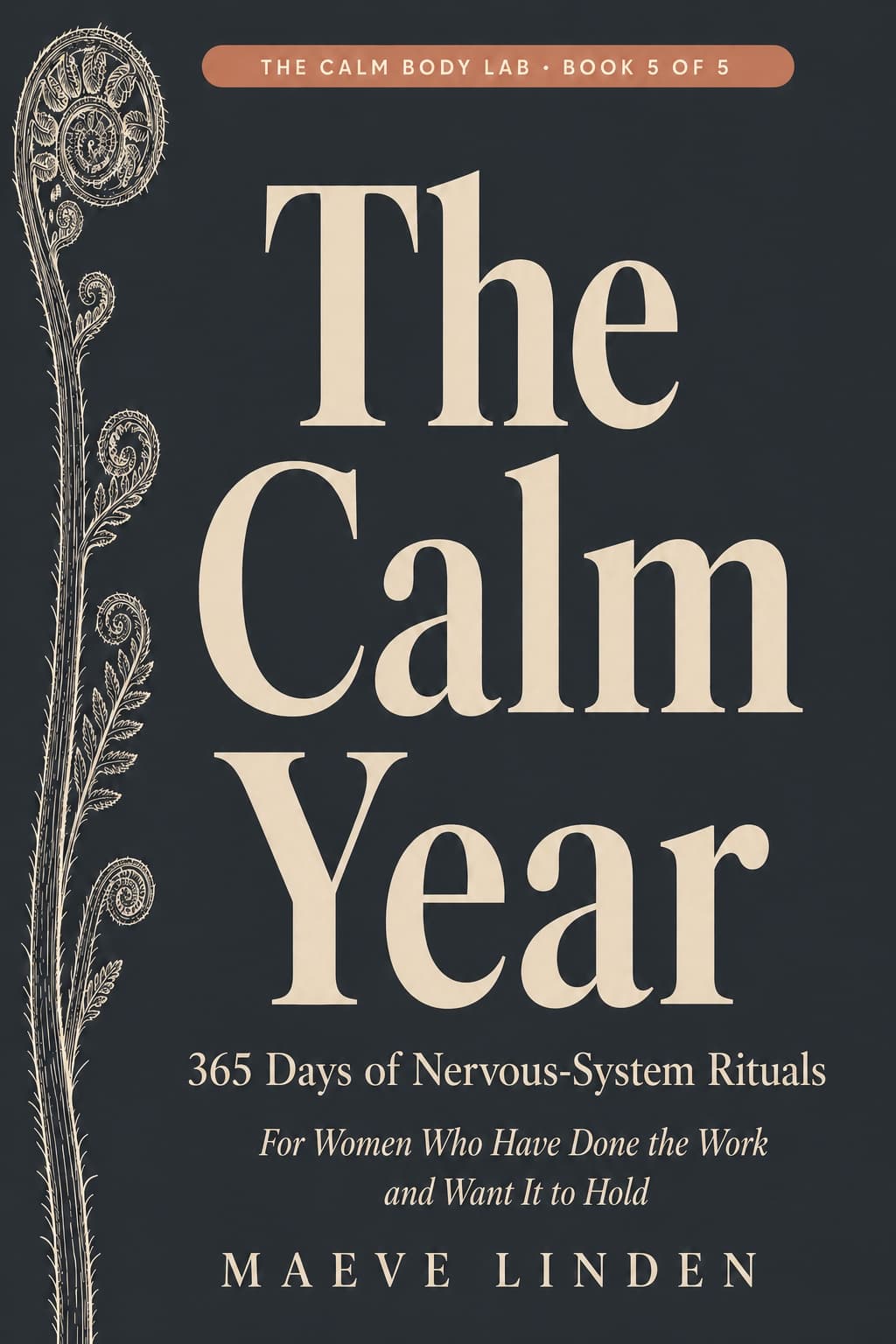
This is the capstone of The Calm Body Lab series by somatic anxiety practitioner Maeve Linden. A 12-month plan organized as one anchor practice per month, three categories of daily integration cues, four quarterly tune-ups, two restoration months built deliberately into the structure, and an explicit anti-streak logic that routes you through drift without making you start over.
Inside, you will find:
- The year-vs-streak distinction, and why the streak-based mental model has been costing you the practice for years, with a body-first reframe that survives missed weeks and missed months
- One anchor practice per month: orienting (Month 1), voo (Month 2), drive vs. freeze (Month 3), the half-salamander (Month 4), the 90-second pause (Month 5), co-regulation (Month 6), transitions (Month 7), glimmers (Month 8), re-entry without restart (Month 9), the quiet morning (Month 10), wintering (Month 11), the repertoire (Month 12)
- The drift-and-return move, the operational sequence for re-entering the practice after weeks or months away, without the streak-residue shame that has sabotaged every prior daily-practice attempt
- Three categories of integration (busy day, regular day, restorative day) so the practice scales to your actual life rather than asking you to optimize toward an aspirational morning routine
- The fallow protocol for Month 11, the deliberate doing-of-less that builds dorsal-rest as a trained skill, distinct from the dorsal-collapse vacations you have been taking
- The repertoire walk, a small, weekly practice for Month 12 that carries the year into Year 2 and beyond
- Four quarterly tune-ups, explicit pause points where you take honest stock, drop what has not landed, and re-locate yourself in the year-frame without ceremony
- The three-practice repertoire, the typical Year-1 outcome (orienting, voo, glimmers) that holds across years and through life-disruption, and the path into Year 2, which is deepening, not restarting
The reader who finishes this book having missed two months and kept ten is more accomplished than the reader who white-knuckled twelve. The book is built that way deliberately.
This is not a workbook. No fill-in pages. No tracking grids. No 30-day reset. No streak app. It is essay-led prose with embedded body-based protocols, the same format as the four books that precede it in The Calm Body Lab series.
For the woman who has done the work and wants it to hold. The five-minute scale is the maximum-sustainable-dose for a real year, and a small practice held for twelve months is materially more than a big practice held for two weeks.
Book 5 (capstone) of The Calm Body Lab by Maeve Linden. Available on Kindle and free with Kindle Unlimited.