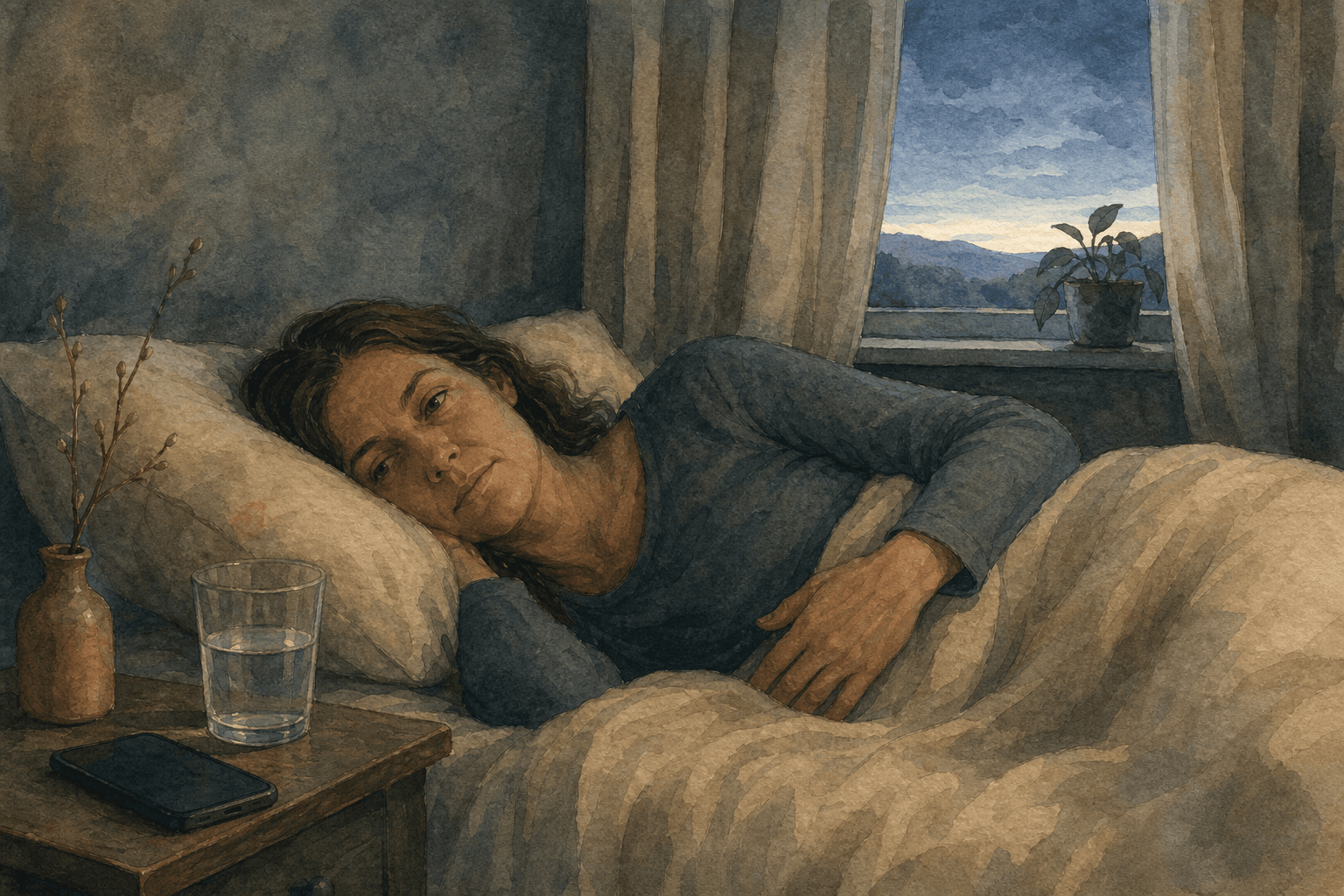
It is 3:14am. You were not dreaming about anything. You did not wake to a noise. You simply surfaced, all at once, with your heart already going and your mind reaching for something to be afraid of, the way a hand reaches for a light switch in a dark room.
By 3:20 it has found something. A work email. A thing you said in 2019. The mortgage. The mole on your shoulder. It does not really matter which one. The fear arrived first, and the thought arrived second to explain it.
I know this hour. I knew it for years before I understood it. I lay in it, certain I was the only person in the house awake, certain that being awake meant something was wrong.
I want to tell you what is actually happening in your body between two and four in the morning, because almost nobody describes it correctly, and most of the advice for it is built on the wrong model.
What the popular advice gets wrong
The gold-standard behavioral treatment for sleep problems is CBT-I, cognitive behavioral therapy for insomnia. For a lot of people it works beautifully, and I want to say that clearly before I complicate it.
CBT-I treats the wake as a problem of conditioned arousal. The idea is that your bed has quietly become a cue for being awake instead of a cue for sleep, so the protocol works to break that association. Do not clock-watch. Do not lie in bed awake. If you are still awake after twenty minutes, get up, go to another room, do something dull in dim light, and come back only when you are sleepy.
That advice is sound for the kind of insomnia it was designed for. The trouble is that it assumes the 3am wake is behavioral, a learned habit of the mind and the mattress.
For a great many chronically anxious women, the 3am wake is not behavioral. It is autonomic. It is the nervous system, not the bedtime habit, that woke you. And for that body, getting up and turning on a light is close to throwing gasoline on the thing you are trying to put out.
What your body is actually doing between 2 and 4am
Two systems are meeting in the dark, and neither of them is a character flaw.
The first is your sleep architecture. The first half of the night is dominated by deep, slow-wave sleep, the most restorative and the most deeply parasympathetic part of the night. The second half tilts toward lighter sleep and more dreaming. By 3am you are simply closer to the surface than you were at midnight. You are easier to wake, and easier to keep awake.
The second is your chemistry. Cortisol, the body's main daytime alerting hormone, is at its lowest around midnight and then begins a slow climb through the early-morning hours toward a peak shortly after you would normally get up. This is not a malfunction. It is the body preparing to meet the day. But in a nervous system that has been running anxious for years, that pre-dawn rise can be earlier and steeper, and it lands you in a lighter stage of sleep in a body already primed to read any activation as danger.
So you wake. Not because something is wrong, but because your chemistry is doing its morning climb a few hours ahead of schedule, in the lightest part of your sleep, in a body that has learned to treat arousal as a threat.
Here is the part the polyvagal model adds. At 5pm, when a similar drop catches most anxious women, there is a whole day of stimuli for the alarm to attach to. At 3am the room is silent and dark and empty. The body is alert with nothing to be alert about, so the mind goes looking for the danger it assumes must be out there somewhere. The 2019 conversation. The mole. The mortgage. The content is almost random. The activation is the real event.
Why this is not insomnia
Clinical insomnia, the kind CBT-I was built for, is fundamentally a problem of sleep drive and conditioned arousal. The anxious 3am wake is often a problem of autonomic state. They can look identical from the outside, and they call for nearly opposite responses.
CBT-I says: reduce the time you spend awake in bed, decouple the bed from wakefulness, and if you are lying there too long, get up. The autonomic read says: do not escalate the arousal, do not flood your eyes with light, stay horizontal, and settle the state you are already in.
This is the same shape I keep returning to in this work. The body wrote the letter first, and the mind ran to find an envelope to put it in. If that framing is new to you, I wrote about it at more length in the body before the diagnosis.
When you treat an autonomic wake with a behavioral tool, you can end up wider awake at 4am than you were at 3, standing in the kitchen in the light, having taught your body that the day has begun. That is not a failure of CBT-I. It is the wrong instrument for this particular wake.
One thing to try this week
This is the move I give clients for the anxious wake. It is quiet, it works lying down, and it does not require you to get up or turn on anything.
The first time you wake this week somewhere between two and four, before you do anything else, try this.
One. Do not turn on the light, and do not reach for the phone. Light is the single strongest signal to your cortisol system that morning has arrived. Leave the room dark.
Two. Stay horizontal. Roll to your back or your side, whichever is comfortable. You are not getting up. The point of staying down is to tell your body, with your body, that the night is not over.
Three. Rest one hand flat on your lower ribs, low, below the chest. The light weight of your own hand is a down-regulating cue, and it gives your attention something physical to land on that is not the fear.
Four. Lengthen your exhales. Breathe in through the nose, ordinary and easy. Breathe out slowly, quietly enough not to wake anyone beside you, and let the out-breath run roughly twice as long as the in-breath. Do not count if counting wakes you up more. Just longer out than in, for a dozen breaths or so.
Five. Orient with your ears, since your eyes have nothing to do in the dark. Find three sounds. The hum of the refrigerator two rooms away. A car somewhere. Your own breathing. Let your attention rest on each one for a few breaths before moving to the next.
The goal of all of this is not to force yourself back to sleep. The goal is to stop adding fear to the wake, because the added fear is usually what keeps you up. Sometimes the sleep returns on its own once you stop fighting the wake. Sometimes it does not, and you lie there warm and breathing until the alarm. In clients I have worked with, that quieter version of 3am, lying still and settled, is a far better night than the version spent scrolling, even when the total hours of sleep are the same.
If you want the foundation under all of this, the orienting and the voo-breath that the rest of the practice is built on, the first book in the series is free at /free.
The full bedtime wind-down, the complete 3am sequence, and the chapter on why perimenopause makes all of this louder live in Polyvagal Sleep, which is the book I wrote for exactly this hour.
Try the horizontal version once this week. You do not have to fix the wake. You only have to stop frightening yourself inside it.
Maeve