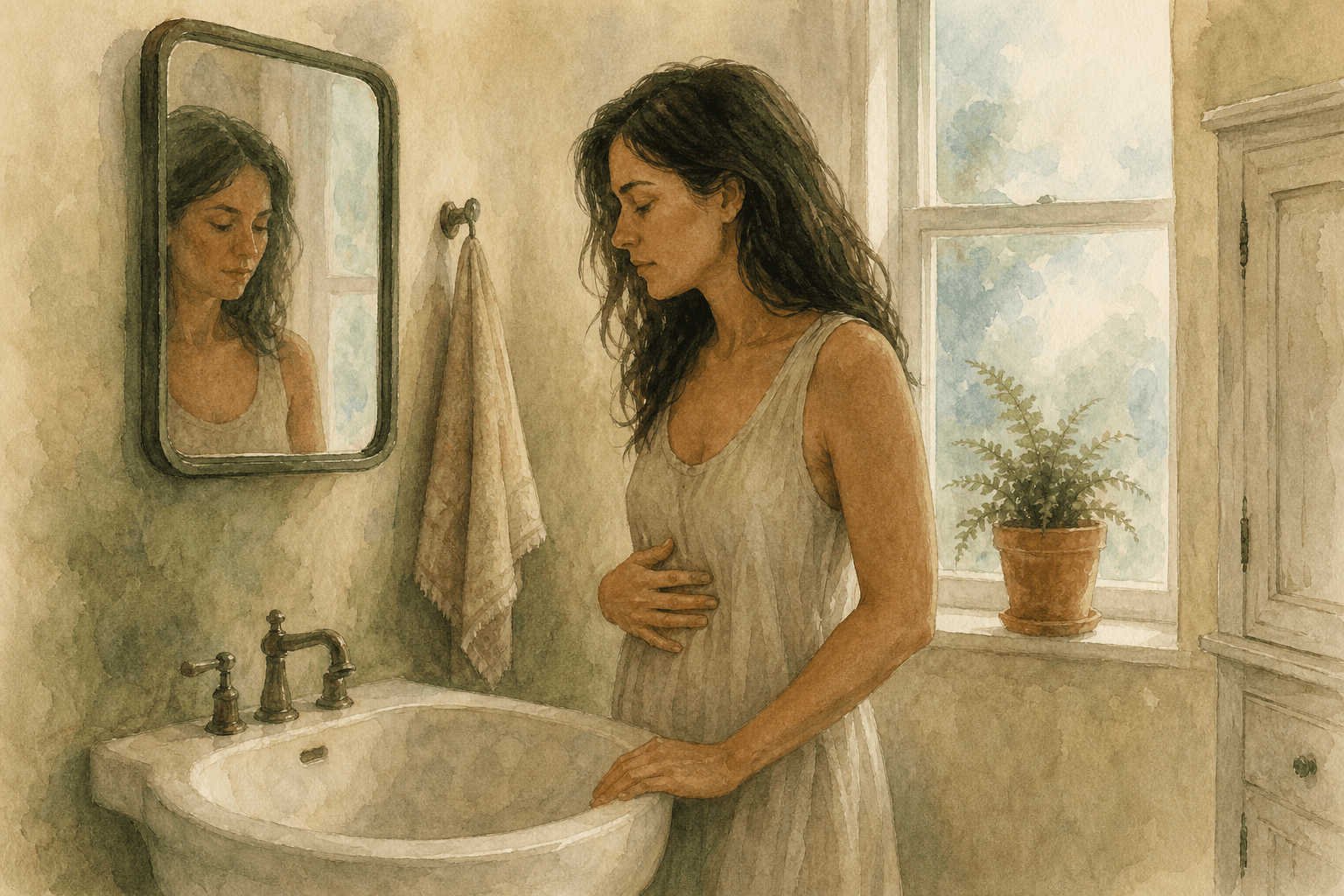
I am thirty-five now. The first time I noticed my own body in any deliberate way was at thirty-three, after a Tuesday in a Trader Joe's checkout line, holding a flat of strawberries. I have told that story already. It is the story most chronically anxious women have somewhere in their twenties or thirties: the day the body finally interrupted hard enough to be heard.
This is a different story. This is the eight years before.
The body had been writing letters
When I went back through my own history, after the diagnosis, I started counting backward. Not because anyone asked me to. Because once I had the word anxiety in my mouth, the years before it started arranging themselves differently in my memory.
There was the year my jaw began clicking when I yawned. I was twenty-five. I assumed it was a wisdom-tooth thing. I did not connect it to the masseter doing the work of holding emotion for me.
There was the eighteen months in my late twenties when my stomach decided, with no warning, to be the problem. I had three GI consults. I ate elimination diets. The conclusion was probably stress, said the way doctors say probably stress, which is to say: dismissively, briskly, and with no follow-up suggestion. I went home and assumed I was being a hypochondriac.
There was the year my shoulders moved up. I do not know exactly when they started living closer to my ears, but a photograph from a friend's wedding in my late twenties shows them already there. They stayed there for most of my thirties.
There was the breath I had been doing for as long as I could remember, which lived almost entirely at the very top of my chest. I did not know breath could live anywhere else until a somatic teacher asked me to put a hand low on my belly during a workshop and see if it moved when I inhaled. It did not. She asked me to put a hand on my upper chest. That one rose like a piston.
I had been carrying this for eight years before the Trader Joe's morning. Probably longer. None of it ever made it to a doctor as anxiety, because none of it looked like the anxiety in the textbooks. I was responsible. I was high-functioning. I was doing well at work. I was capable of running a household.
The body had been writing me letters for the better part of a decade. I had been throwing them away unopened.
What the popular advice misses
Most of the popular language around anxiety assumes you already know you have it. Mindfulness apps, CBT worksheets, the conversation with a friend over coffee. They presume the conscious mind has named the thing and now the work is to manage it.
For a startling number of chronically anxious women, the conscious mind has not named the thing at all. The body has been carrying the load alone for years. Sometimes decades. The jaw, the ribs, the gut, the sternum, the shoulders. The body has been doing the storage work the brain has not signed off on.
This is one of the central observations Bessel van der Kolk spent a career documenting in The Body Keeps the Score. The body stores what the mind has not yet metabolized. It does not wait politely for our cognition to catch up. It compresses the stored material into tissue, posture, breath pattern, gut function, sleep architecture.
The polyvagal model adds something to this. It is not just storage. It is state. Years of high-functioning anxiety teach the nervous system that a certain baseline (mild sympathetic activation with a layer of dorsal collapse underneath) is the normal one. The body does not interpret the chronic state as a problem. It interprets it as the operating system. By the time the conscious mind names it, the operating system has been running for a long time.
This is why so many women, after the diagnosis, look back and say of course. The of course is the body's letters becoming readable.
Why this matters even after you know
If you are already in the practice (the meditation app, the CBT worksheets, the breathwork, the somatic work, the year of slowing down) you might think the body-before-the-diagnosis question is behind you. You have the words now. You are working on it.
I want to gently disagree.
Two things tend to happen for women who skip the body-history step. The first is that they keep using the intensity of their current anxiety as the metric for whether they are making progress, without ever checking how much load the body had been carrying as baseline. The needle moves on the surface and the underlying load stays invisible. The body knows. The data is in your tissue.
The second is that they keep getting surprised by what they call backslides. The 5pm collapse on a Tuesday in March. The Sunday-night chest tightness that returns three months into the practice. The migraine that arrives during what was supposed to be a restorative weekend. These are not backslides. These are the older body-letters arriving on schedule, asking to finally be read.
There is also a quieter reason to do this work, which has nothing to do with progress. Naming the body-before-the-diagnosis is how a chronically anxious woman makes peace with the years she has been calling who I am. Those years were not who you are. They were who your nervous system had been protecting you from being.
That is worth a five-minute exercise.
One small body-history exercise to try this week
You will need a piece of paper and ten minutes.
Down the left side of the paper, write the years between your earliest clear memory and now. One year per line. Most of my clients end up with twenty-five to forty lines. That is fine.
Beside each year, write any body symptom or pattern you can remember from that year, no matter how small. The jaw click. The Sunday-afternoon stomach. The year you started getting up before everyone else in the house because the morning was the only time your body felt available. The migraines from the autumn of 2017. The cold hands that you have had since high school. The breath that has lived at the top of your chest for as long as you can remember.
Do not interpret. Do not diagnose. Do not try to remember every symptom. Just write down what arrives.
When you are done, read the page top to bottom.
That is the exercise. There is no second step. The naming is the work.
If you have wanted to put the body-before-the-diagnosis on paper but did not know where to start, that is where to start.
The chapters in Vagus Nerve Reset for Women With Chronic Anxiety that introduce orienting and the voo-breath are the next layer.
You can read the first chapter for free at /free if you want the foundation of the practice.
The full book lives at /books/B0H174L5DJ once you are ready for it.
The body-history exercise comes before any of them, because the practice lands differently once you have read the letters the body has been writing.
For more on what this newsletter is and what to expect from it, see the first letter from The Calm Body Lab.
Read your body's letters this week. That is enough.
Maeve