About this book
What you’ll find inside.
You will read this book the way you do most things: fast, in the corners of an already-too-full week, on a flight, at 11pm. The version of you that is reading right now is the version this book is about.
Your inbox is at zero by 7pm. Your calendar is tetris-locked the week before. Your colleagues call you the dependable one, the closer, the absolute machine. Your jaw is tight at 5pm and you cannot remember whether you ate lunch. Your body collapses on day two of vacation. You have read the books, Suglani, the Nagoski twins, Aarons-Mele, Brené Brown, recognized yourself in each one, and the pattern is still your operating mode.
The reason is not your effort. The pattern lives in your physiology, not in your cognition. What you have been calling your competence is, in part, a polyvagal pattern with a known shape: freeze-disguised-as-productivity overlaid with fawn-disguised-as-being-helpful. Cognitive interventions cannot reach that layer. The body needs its own protocol.
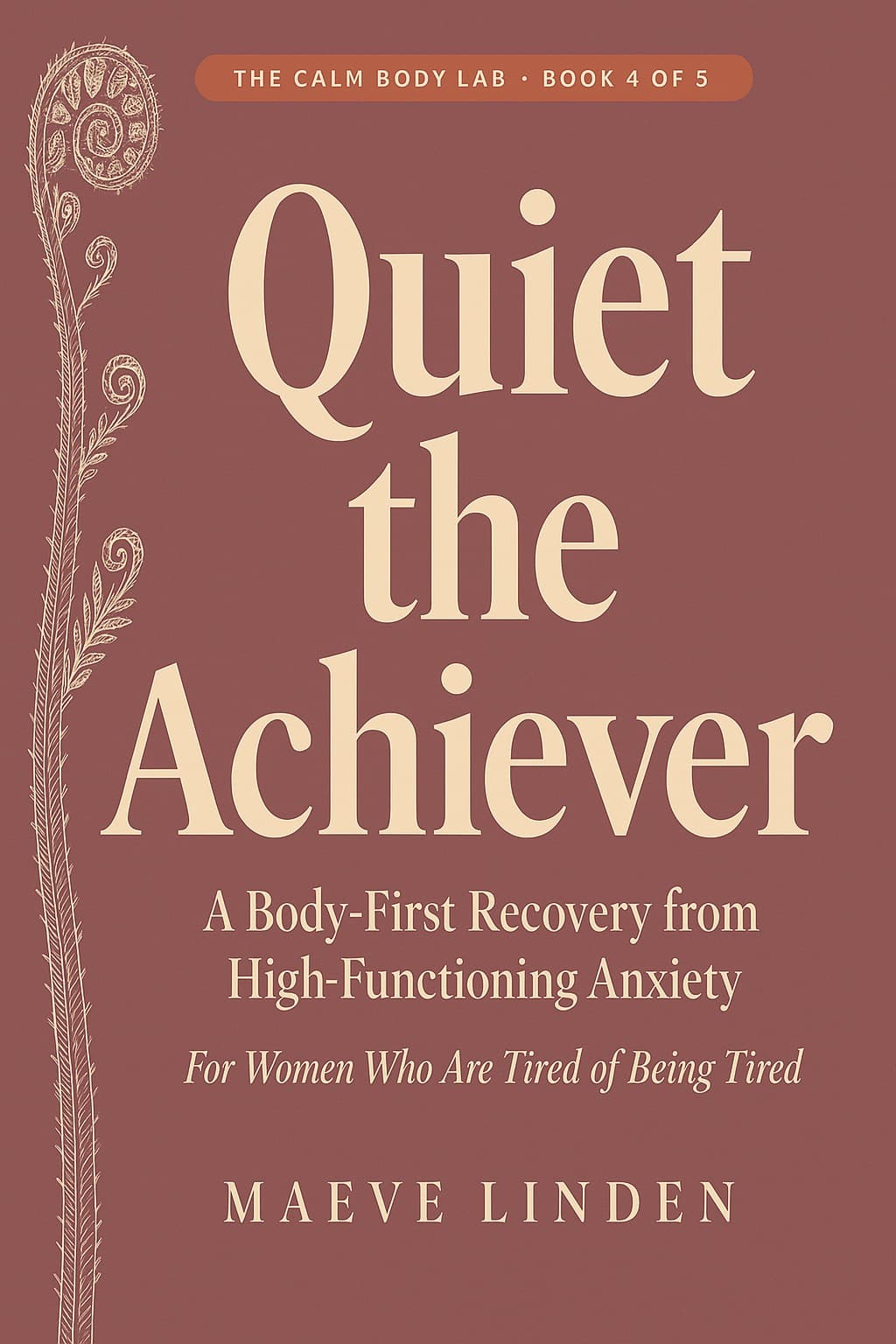
This is the fourth book in The Calm Body Lab series by somatic anxiety practitioner Maeve Linden. A body-first complement to the cognitive work for driven women whose high-functioning anxiety has become indistinguishable from their identity. Twelve weeks of micro-interruption, distributed across the workday you already have, that gradually unwind the pattern without dismantling the drive you actually want to keep.
Inside, you will discover:
- The eight patterns of high-functioning anxiety (slight-aheadness, absent body, 5pm jaw, Sunday-night chest, vacation collapse) so you recognize the pattern without diagnosis
- The drive vs. freeze distinction, different polyvagal states, different felt-signatures, and the 30-second body-check that tells you in real time which one you are in
- The polyvagal physiology of HFA, partial-freeze baseline, the stress cycle that has not been completing, the cumulative-cortisol curve, and how perimenopause amplifies the pattern
- The fawn half of HFA (anticipatory helpfulness, low-maintenance self-presentation, reflexive yes, over-explanation) and the body-first moves that unwind it
- The three categories of micro-interruption (during-task 30 to 90 sec, between-context 3 to 5 min, evening genuine-rest 8 to 12 min) sized to fit inside the workday, not on top of it
- The workday protocol (body-check, longer-exhale, threshold pause, phone-down, slow walk) runnable invisibly in any professional environment
- The evening genuine-rest practice that gradually replaces the wine-and-phone wind-down and resolves the vacation-collapse pattern by month four to six
- The twelve-week arc, the week-3 backslide, the week-6 grief layer, and how the protocol coexists with SSRIs, ADHD medication, ongoing therapy, demanding jobs, and family
- How to keep the drive and drop the freeze, the central work of the book, and unoccupied space on the high-functioning-anxiety shelf
Not a productivity book. Not an anti-productivity manifesto. Not a quit-your-job book. Not a boundaries book. It is the body-side complement to the cognitive work you have already done. For the woman who has read Suglani's High-Functioning Anxiety, Aarons-Mele's The Anxious Achiever, and the Nagoski twins' Burnout, and noticed that the pattern is still her operating mode.
You are not asked to become a different woman. You are asked to know which signals are drive and which signals are freeze, and to give the body the small daily completions it has been finishing in collapse on day two of every vacation.
Book 4 of The Calm Body Lab by Maeve Linden. Available on Kindle and free with Kindle Unlimited.