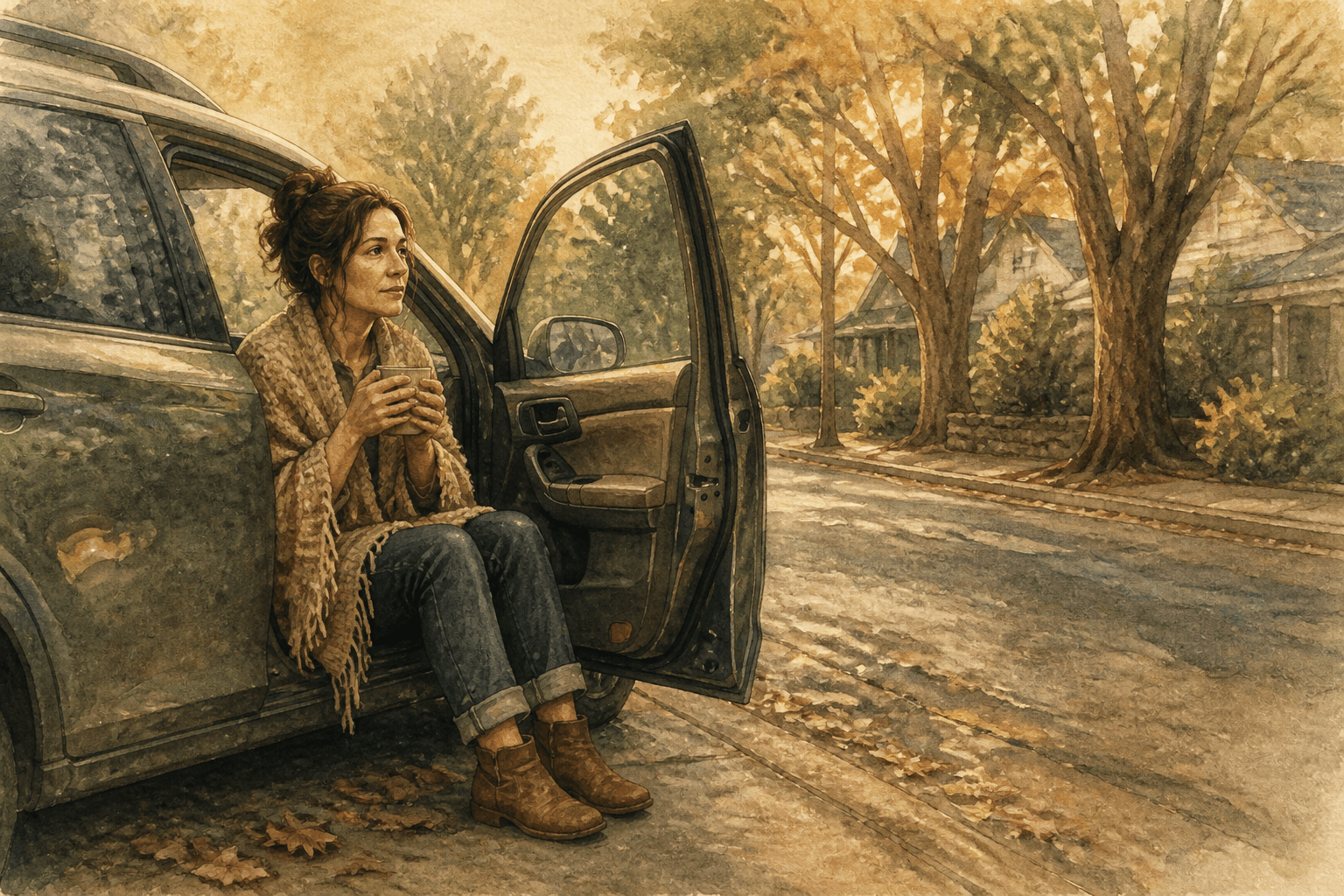
The car is parked outside your daughter's school with the engine off. The clock on the dashboard says 3:11, and pickup is at 3:15.
The worst of the attack is over. Your heart has come down out of your throat, and your hands have stopped buzzing. So you dab under your eyes, check your face in the mirror, and go and stand with the other parents.
You make dinner. You answer the email you were going to answer. By any measure anyone can see, you are fine.
Except your legs feel as if they ran somewhere without you. You are cold in a warm kitchen. You snap at someone over nothing. And somewhere around ten that night, lying very still, the thought arrives: what if it happens on Thursday, in the meeting, in front of everyone.
What the popular advice misses
Almost everything written about panic is about the peak: breathe in a square, name five things you can see, count backward from a hundred.
Some of that has its place. Very little of it says what to do once the peak has passed, and that is where a lot of women quietly lose the next day, and sometimes the next week.
Where panic keeps its grip
The National Institute of Mental Health has a plain-language page on panic disorder. It lists what you would expect: a pounding heart, sweating, trembling, chest pain, a sense of being out of control.
Then it lists two more that are easy to read past. An intense worry about when the next attack will happen. And avoiding places where attacks have happened before.
Both of those happen in between attacks: in the car afterward, at ten that night, on the drive you start taking the long way around.
So the hours after an attack deserve as much care as the attack itself. That is usually where the replaying starts, and replaying is how the dread of the next one tends to grow.
A word before anything else. If this was your first attack, or the first in a long while, or it came with chest pain, fainting, or a heart that raced in a way that is new for you, please see a doctor before you file it under panic. If you have chest pain right now, call 911. Nothing in this letter is a reason to wait.
What the come-down can feel like
When the peak passes, the body does not go straight back to how it was.
You might shake, a little or a lot, in your thighs or your hands. You might cry without knowing what about. You might feel hollow, or far away, or so tired you could sleep in the car. You might be ravenous, or unable to face food.
All of that is common, and none of it means another attack is starting.
In The Panic Code I wrote that the culture we live in does not have a slot for the descent. We are expected to wipe our faces and go back in. It is the same habit I wrote about in the letter on day two of a holiday: going straight from the hard thing back to the list, as if stopping were the risk.
A plan for the hour after
Here is what I ask for in the book, before you go back to anything. Four things, in any order.
Sit somewhere you can stay put for a while, and sip something warm. Water, or a tea without caffeine, in small slow sips. Save the coffee for tomorrow.
Eat something, even if you are not hungry. A little protein and a little carbohydrate: eggs and toast, a yogurt, peanut butter on an apple. Small is fine.
Walk slowly. Slower than feels natural, noticing each foot as it lands. Outside if you can, down the hall and back if you can't. If you can't move around at all, shift your weight from one foot to the other.
Get warm. A sweater, a blanket, a warm shower later on.
None of it is clever, and that is on purpose. In the hour after an attack you may not be at your best for deciding things, so it helps to have decided already, and to have tried the walk once on a calm day.
You probably will not feel fine at the end of it, and you do not need to. What you are looking after is the rest of the day, and the next morning.
When the what-ifs start
Some hours later, often when you are lying down, the thoughts come. What if it happens in the meeting. What if it happens in the car with the kids. What if this is just how it is now.
You do not have to argue with them. In the book I suggest something smaller: notice where they are coming from, and say so, quietly. Something like I am still shaken up from earlier, and a shaken-up body imagines the worst.
Then let one breath out, a little longer than the breath in, with no need to breathe deeply first. Go back to whatever you were doing. If the thought comes back, do it again. It usually does come back, and that is fine.
One more thing to watch for. If you notice your world getting smaller (places you have stopped going, the road you now drive around), please bring that to a clinician who works with panic. That is the second item on the NIMH list, and it deserves real help from someone trained in it.
Alongside the rest of your care
The four things in the plan are for getting through the rest of a hard day, and some people find they help. Treating panic is work for a doctor or a therapist who knows it, and nobody can promise you an end to attacks. I would be wary of any book that does.
So keep whatever your doctor or therapist already has you doing. This replaces none of it. If you ever have thoughts of harming yourself, call or text 988 in the US, or your local emergency number.
The Panic Code assumes you already have a few simple moves in your body, like a slow look around the room you are in. Those start in the first book of the series, which is free.
One thing to try this week
Once this week, on an ordinary day when nothing is wrong, rehearse the slow walk, so your body has done it once before it needs to.
Pick a stretch you could really use after an attack: the hallway at home, the block around your office, the edge of the school parking lot.
Walk it for a few minutes, slower than feels natural. Notice each foot as it lands, the heel first and then the rest of it. When your mind wanders off, bring it back to your feet.
Maeve